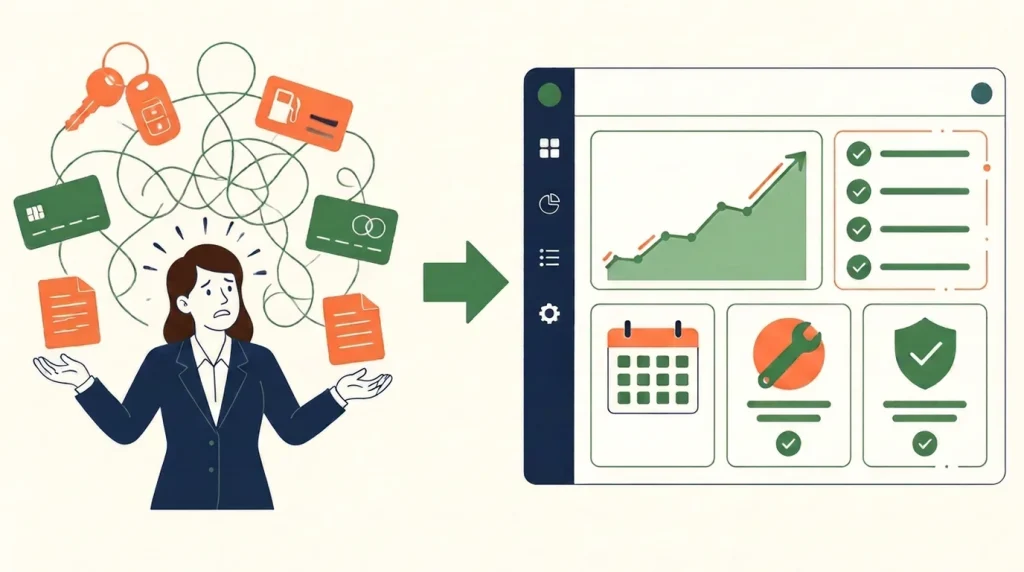
Nobody sets out to become their company’s fleet manager. The role just gets absorbed, one vehicle at a time, until someone is spending their Friday afternoons chasing service bookings and registration renewals instead of doing the job they were hired for. At some point most businesses stop and ask whether there’s a better way to run it. This guide from Your Fleet Team covers what outsourced fleet management actually involves, how it compares to keeping it in-house, the signs it’s time to make the change, and the situations where outsourcing genuinely isn’t the right answer.
Key takeaways
- For most businesses running more than fifteen to twenty vehicles without a dedicated fleet role, outsourcing is worth it. Below that, or where a capable full-time fleet manager is already in place, in-house usually still makes sense
- Outsourced fleet management means a dedicated external team runs the day-to-day admin, compliance and driver safety monitoring, while your business keeps the final say on every decision
- There are three workable models, in-house, hybrid and fully outsourced, and fleet size and complexity decide which one fits
- The real cost of keeping it in-house is mostly hidden: compliance that quietly slips, savings nobody is looking for, and key-person risk
- The clearest signals it’s time to outsource are fleet admin outgrowing internal capacity, renewals or inspections slipping, or nobody being able to say whether your fleet costs are competitive
- It applies whether your vehicles are owned outright, leased, or a mix of both
What is outsourced fleet management?
Outsourced fleet management means handing the day-to-day running of your vehicles to a dedicated external team, while you keep control of the decisions that shape your business. It isn’t a software subscription, and it isn’t a call centre. It’s a team that gets to know your operation and takes over the admin, compliance and performance tracking that comes with running vehicles.
The distinction matters because a lot of businesses assume outsourcing means losing control. It doesn’t. Servicing schedules, registration renewals, fuel and toll admin, driver safety monitoring, and the reporting that ties it all together move off your desk and onto someone else’s. You still make the call on anything that affects your business. What changes is who does the legwork.
It’s also worth separating this from fleet leasing, because the two get confused often. Leasing is about how you finance and structure vehicle ownership. Outsourced fleet management is about who handles the operational side, and it applies whether you own your fleet outright, lease it, or run a mix of both.
In-house, hybrid or fully outsourced: which model fits your fleet?
There are three genuine ways to manage a fleet, and the right one depends on how big your fleet is, how complex it is, and how much internal capacity you actually have. None of them is universally correct.
| In-house | Hybrid | Fully outsourced | |
| What it looks like | Your own team runs the fleet, usually alongside other duties, often with fleet software to support them | Day-to-day admin stays in-house, the complex parts like compliance, procurement or strategy go to a specialist | A dedicated partner runs the whole operation, from servicing and compliance through to reporting |
| Best suited to | Small, low-complexity fleets, or businesses with a genuine full-time fleet role already in place | Fleets with capable internal admin support but clear gaps in specialist knowledge | Fleets where admin, compliance or cost visibility have outgrown what the business can carry internally |
| Strengths | Complete control, and the knowledge stays inside the business | Specialist input on the hardest parts without handing over the whole operation | Resourcing scales with fleet size rather than sitting on your books as fixed overhead, and you get expertise you’d struggle to justify hiring |
| Trade-offs | Software and training costs that don’t go away, responsibility for keeping vehicle and driver data secure, and real key-person risk if the trained person leaves | Shifts the burden rather than removing it, and only works if everyone is clear on who owns what | An ongoing service cost, less fleet knowledge built internally, and you’re relying on a provider to deliver what they promised |
A five-vehicle fleet with straightforward requirements might run perfectly well in-house. A twenty-vehicle fleet that’s already stretching someone thin is a different conversation entirely. The hybrid model sits between the two and suits businesses that have the admin capacity but not the specialist knowledge, though it’s the one that most often falls apart when responsibilities aren’t nailed down properly at the start.
The hidden costs of keeping it in-house
The obvious cost of in-house fleet management is time. The bigger cost is what gets missed when fleet admin is squeezed into the gaps of someone’s actual job.
- The work that isn’t getting done instead. Every hour spent chasing a service booking is an hour not spent quoting jobs, following up leads, or looking after existing customers. Fleet admin rarely grows a business.
- Compliance that quietly slips. A registration renewal or safety inspection buried under other priorities can mean fines, vehicles pulled off the road, and liability the business didn’t need to carry. It’s almost never deliberate. It’s what happens when a task competes with a dozen others and loses.
- Savings nobody is looking for. A part-time fleet person isn’t tracking fuel efficiency trends, benchmarking servicing against what’s reasonable, or renegotiating insurance, because that was never their job. Those oversights compound quarter after quarter across every vehicle.
- Reactive rather than planned lifecycle management. Without someone watching servicing schedules properly, small issues get caught late, repair bills climb faster than they need to, and replacement decisions get made in a rush.
- Key-person risk. When the person holding it all together moves on, you’re not just replacing an admin task. You’re replacing someone who knew your entire fleet, and AHRI research puts the average cost of replacing an employee at around $23,860 once recruitment, onboarding and training are counted.
None of this arrives as a single invoice. It shows up as a series of small, avoidable costs that quietly outweigh whatever the business thought it was saving.
Signs it’s time to consider outsourcing
The clearest sign is when fleet admin starts consuming time that should be going into running or growing the business. A few other patterns usually show up alongside it:
- Vehicles go off the road unexpectedly, because maintenance is reactive rather than scheduled
- There’s no real visibility into what drivers are doing on the road
- Costs swing month to month, and nobody has the time to work out why
- Compliance paperwork, particularly around Chain of Responsibility obligations, doesn’t feel as tight as it should
- Nobody on the team has the time or the specific expertise to run fleet admin properly
- The fleet is growing, or fluctuates seasonally, faster than your current systems can keep up with
- You can’t answer, with confidence, whether your servicing and insurance rates are competitive
None of these point to a badly run business. They point to a business that has outgrown the spreadsheet-and-good-intentions approach, which is a normal stage to reach. The real question isn’t whether your fleet needs more structure. It’s whether you want to build that structure internally or bring in a team that already has it.
What an outsourced fleet department actually does
An outsourced fleet department takes over the operational tasks that keep vehicles safe, compliant and on the road, so nothing falls through the cracks between jobs.
| Area | What’s handled |
| Fleet management platform | A single platform where all your vehicle data and history lives |
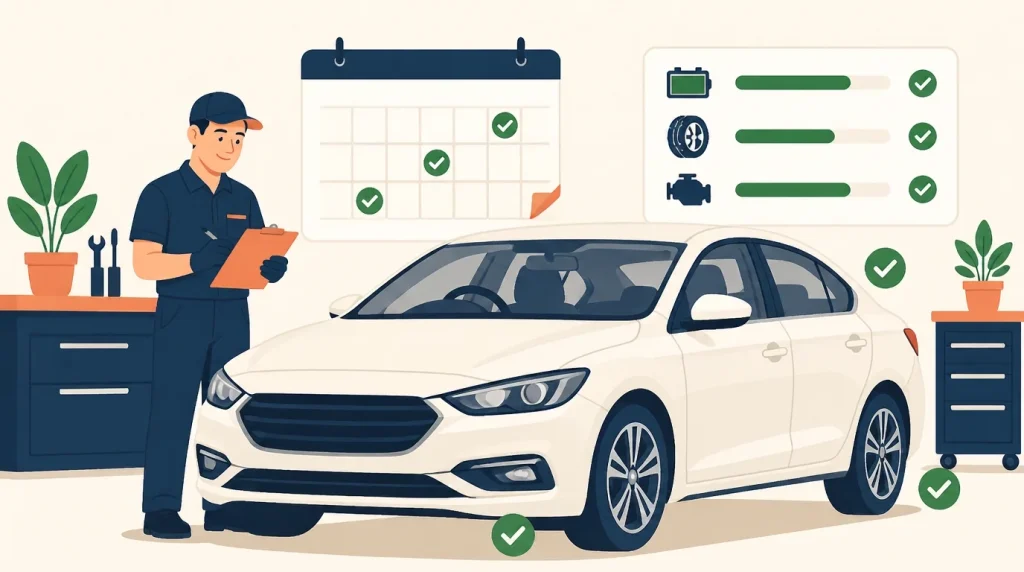
| Maintenance | Scheduling and managing servicing before it becomes a breakdown |
| Tyre management | Monitoring wear and scheduling replacements before they become a safety issue |
| Registration and CTP | Tracking renewal dates and paying on time across every vehicle |
| Fuel management | Card admin, and reviewing spend for waste or misuse |
| Toll management | Setup, eTags and back-end admin |
| Infringements | Matching fines to the correct driver and tracking patterns |
| Roadside assistance | 24/7 cover so drivers are supported if something goes wrong |
| Driver safety | Monitoring behaviour and coaching drivers before incidents happen |
| FBT automation | ATO-compliant electronic logbooks, no manual paperwork |
| Compliance | Supports CoR compliance and keeps documentation audit-ready |
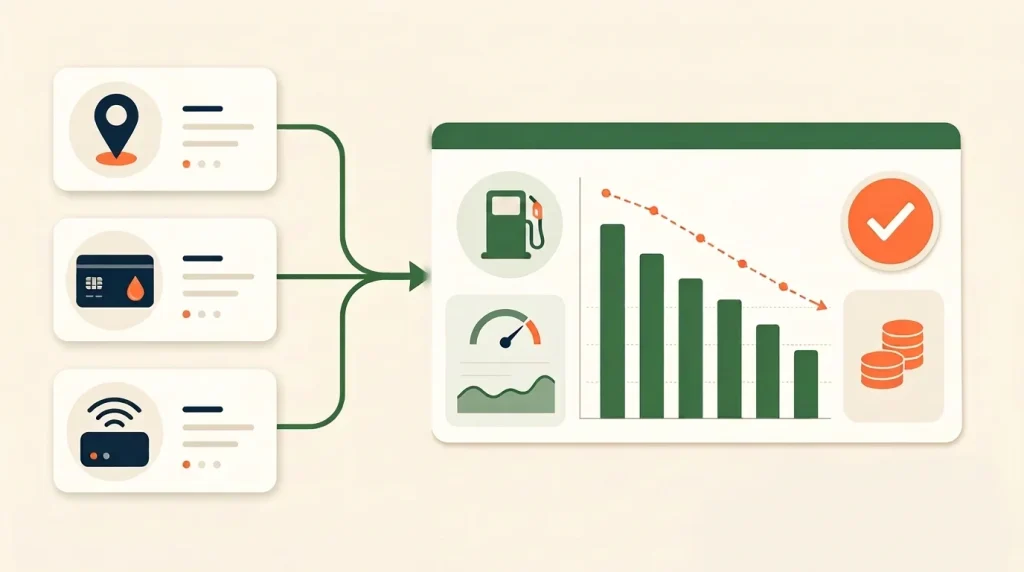
| Reporting | Turning fleet data into insights you can act on |
| Dedicated support | A named, Australia based account manager who knows your fleet |
The value isn’t only that these tasks get done. It’s that they get done consistently, by a team whose entire job is to stay across every vehicle, every renewal and every data point. That’s a hard standard to hold internally when fleet admin is one of six things on someone’s plate.
When outsourcing isn’t worth it
Outsourcing isn’t the right answer for every business, and it’s worth being straight about where it doesn’t stack up.
If you’re running two or three vehicles with predictable use and no compliance complexity, a shared calendar and a decent set of reminders will probably serve you fine. The admin burden at that scale is real but manageable, and the savings a provider can find across three vehicles won’t usually justify the arrangement. We generally recommend outsourced fleet management from fifteen to twenty vehicles upward, because that’s where the time and risk start to outweigh what it saves.
It also isn’t the answer if you already employ a capable full-time fleet manager who has the systems and the time to do the job properly. In that case you have the structure already, and what you might need is better technology or specialist support on specific areas, which is the hybrid model rather than a full handover.
And if your business genuinely wants to build fleet expertise internally as a long-term capability, outsourcing works against that. You’ll get the outcome, but the knowledge sits with the provider rather than with your team. That’s a legitimate reason to choose a different model, and it’s worth deciding deliberately rather than by default.
So, is it worth it for your business?
For most businesses running more than fifteen to twenty vehicles without a dedicated fleet role, yes. The reason is straightforward: the costs of doing it yourself scale with every vehicle you add, while a managed service scales far more predictably.
The honest test is whether the time, missed savings and compliance exposure currently sitting inside your business add up to more than a managed service would cost to run. That’s a question worth answering with your actual numbers rather than a general rule, which is exactly what a fleet assessment is for.
If your team is already stretched, if renewals or inspections have slipped before, or if nobody in the business can say whether your fleet costs are competitive, those are the signals worth acting on.
What to expect when you bring in a partner
Bringing in an outsourced fleet management partner should feel like gaining a team member, not losing visibility. At Your Fleet Team, the relationship starts with an audit of your current fleet, so we understand exactly what we’re taking on before anything changes. The handover then happens without disrupting how your drivers already work.
Beyond that first few weeks, there are four things worth holding any provider to:
- One person who knows your fleet. A named, Australia based account manager, not a ticket number and not a rotating contact who has to be re-briefed every call. They should know your business, your vehicles and your cycles well enough that you never have to explain your operation twice.
- Complete clarity on where every dollar goes. A predictable monthly investment with no hidden fees, and cost reporting per vehicle so you can see exactly what each one is costing you to run and why. If a provider can’t tell you plainly what sits inside the fee and what doesn’t, that’s worth pressing on before you sign anything.
- Reporting that tells you what to do, not just what happened. Monthly reporting should arrive before you have to chase it, and it should be written in plain English rather than handed over as raw data for you to interpret. The point isn’t the dashboard. It’s that someone has already looked at it, spotted the opportunity or the problem, and told you what it means for your business.
- Problems flagged before they cost you. A worn component picked up in the telematics data, a driver behaviour pattern worth a conversation, a replacement cycle that should be planned now rather than dealt with urgently in six months. Being ahead of these is the difference between a partner and a supplier.
The last thing to look for is whether the service is designed to improve. Most providers deliver the same thing in year three as they did on day one. The relationship should get sharper over time, because the longer a team works with your fleet, the more it understands about how your vehicles are actually used and where the money is really going.
To discuss whether outsourcing your fleet is right for your business, contact us today.
Frequently Asked Questions
Is there a minimum fleet size for outsourced fleet management?
We generally recommend outsourced fleet management for fleets of fifteen to twenty vehicles or more. Below that, the time and cost savings tend to be less significant, though it’s worth getting in touch to talk through your specific situation.
What’s the difference between in-house and outsourced fleet management?
In-house means your own team carries the admin, compliance monitoring and driver safety oversight, usually alongside other responsibilities. Outsourced means a dedicated external team does that work, with your business keeping the final say on decisions.
Can I outsource just part of my fleet admin?
Yes. Some businesses hand over the entire operation, others start with the parts that carry the most risk or eat the most time, like compliance or maintenance scheduling, and keep the rest in-house. That’s the hybrid model, and it works well as long as responsibilities are clearly defined.
Can you take over a fleet that’s already mid-lease or managed by another provider?
Yes. Taking over an existing fleet, whether it’s owned outright or already leased, is one of the most common starting points. The transition is designed to happen without disrupting your drivers or day-to-day operations.
Does outsourced fleet management help with Chain of Responsibility compliance?
It supports CoR compliance by keeping fleet records, maintenance history and driver safety data organised and accessible. That documentation is part of what a business needs to demonstrate compliance, though the CoR obligations themselves always remain with the business.
Find out whether it’s worth it for your fleet
We’ll look at your current fleet, what it’s costing your team to run, and give you a straight answer on whether outsourcing makes sense for your business. If it doesn’t, we’ll tell you that too.